
“Stories and lessons from an unexpected journey in finance.”
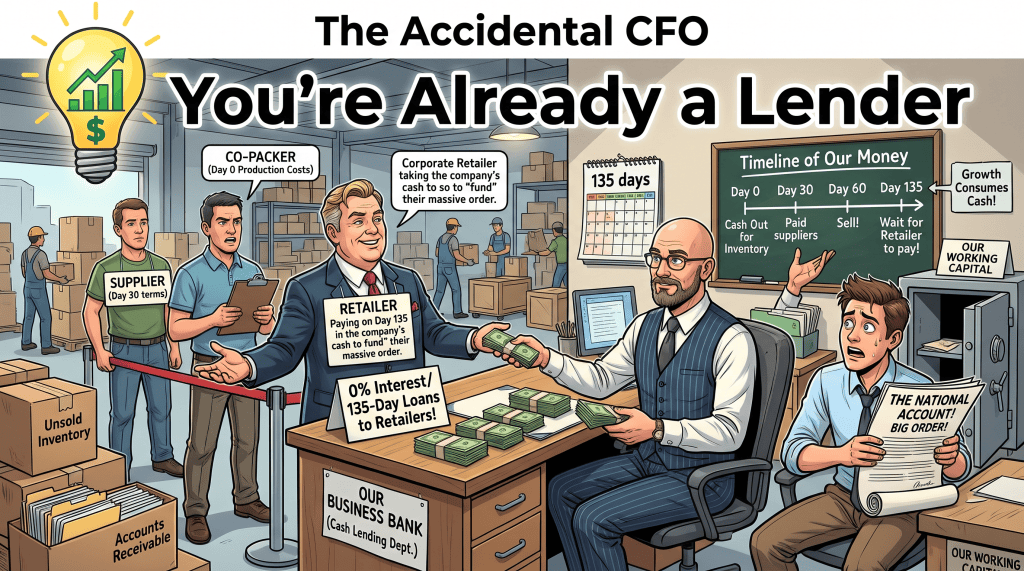
Every business lends money. Most don’t know how much, or to whom.
Here’s the simplest way to see it. Count the days between the moment cash leaves your account and the moment cash comes back.
Three things determine that number. How long you hold inventory before selling it. How long customers take to pay you after you’ve delivered. And how long you take to pay your own suppliers.
Add the first two, subtract the third. That’s your cash conversion cycle. A count of the days your money is somewhere else.
For a restaurant, the number is usually negative. They buy food on thirty-day terms, cook it, and sell it tonight. The customer pays before they leave. Suppliers are funding the business, interest-free, in the ordinary course.
Now the other end.
I’ve sat on the board of a consumer goods business, and the arithmetic there runs the opposite direction. You pay a co-packer to produce inventory. It sits in a warehouse. You ship it to a retailer who pays you on their terms, not yours and their terms are long because they can be.
Buy at day zero. Sell at day sixty. Collect at day one hundred and thirty-five. Pay your own suppliers somewhere around day thirty.
That’s over a hundred days where your cash is funding somebody else’s business.
Here’s the part that catches people, and it catches good operators.
If your cycle is positive, growth consumes cash.
The dangerous moment in a consumer brand isn’t a bad quarter. It’s the big order. The national account everyone has been chasing finally says yes and now you have to produce and ship before you see a dollar. The better the news, the bigger the hole.
This is how profitable, growing companies run out of money, and why the founder is genuinely bewildered when it happens.
The three levers aren’t equally hard. Everyone attacks collections, because chasing customers feels like action. Fewer ask why inventory sits as long as it does. Almost nobody renegotiates supplier terms, which is often the cheapest win on the table.
Profit tells you whether the business works.
The cash conversion cycle tells you who’s funding it while you find out.
Do you know your number and which of the three levers you’ve never actually pulled?
#TheAccidentalCFO #FinancialLiteracy #CashFlow #WorkingCapital #INERSEC


Leave a Reply