
“Stories and lessons from an unexpected journey in finance.”
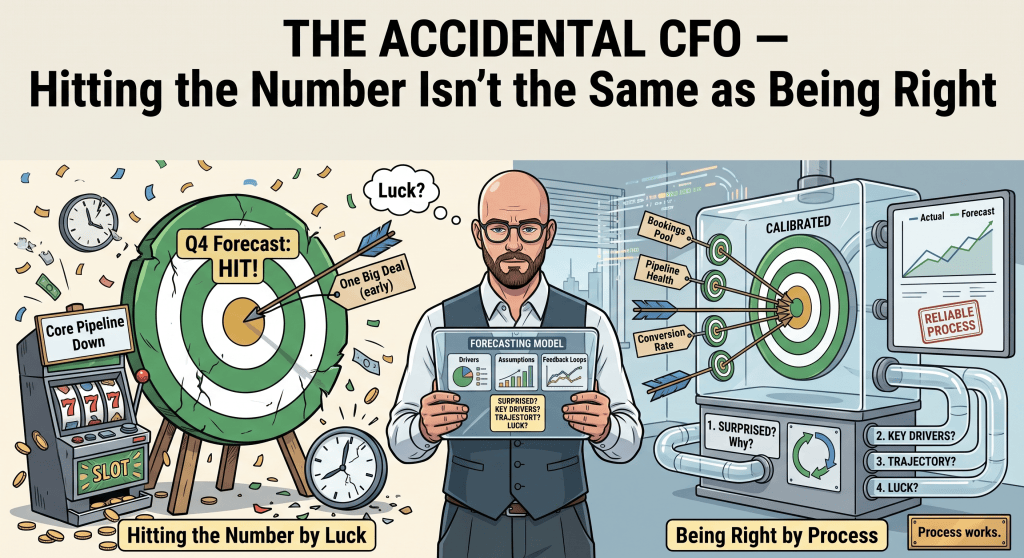
The quarter is closed. Over the next two weeks, most companies will hold a version of the same meeting: did we hit the number?
It’s the wrong first question.
Hitting the number and being right are different things, and the gap between them is where the useful information lives.
Consider two quarters. In the first, you forecast $10M, delivered $10.1M, and every driver landed roughly where you said it would. In the second, you forecast $10M and delivered $10.2M — but only because one deal closed three quarters early while your core pipeline underperformed by 15%.
Both are green on the board deck. Only one of them tells you your forecasting works.
Four questions I’d ask instead, in this order.
What did we get wrong, and why didn’t we see it? Not what missed. What surprised us. A miss you predicted in week two is a business problem. A miss that arrived unannounced in week eleven is an information problem, and information problems compound.
Which drivers actually moved the outcome? Usually it’s one or two, and usually they aren’t the ones getting the most attention in the review. I’ve watched a company treat a Professional Services decline as a delivery problem for two quarters before anyone traced it back to how the bookings pool was constructed.
What does this quarter change about the full year? This is the question boards actually want answered, and the one most retrospectives skip. A quarter is only interesting as evidence about a trajectory.
And the uncomfortable one: what did we get right by accident? Nobody asks this, because green is green. But a number you hit for reasons you didn’t plan is luck, and luck doesn’t repeat on a schedule.
Here’s the test for whether your retrospective is working.
If the meeting produces an explanation for the variance, you’ve written history.
If it produces a change to how you forecast next quarter, you’ve done something useful.
Most quarterly reviews are the former wearing the clothes of the latter.
When did your last quarterly review actually change how you forecast?
#TheAccidentalCFO #FPandA #QuarterEnd #FinanceLeadership #INERSEC


Leave a comment