
“Stories and lessons from an unexpected journey in finance.”
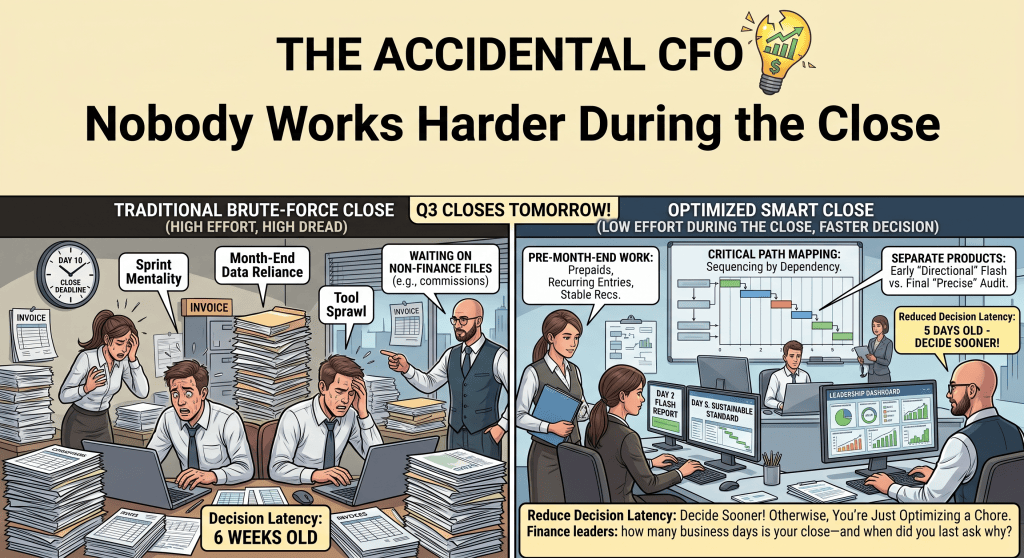
Q3 closes tomorrow. Somewhere in your building, someone is already dreading the next ten days.
I’ve taken a close from 45 days to six. I’ve compressed another to four business days — better than a 50% improvement — and redesigned it toward a sustainable five-day standard.
In none of those cases did anyone work harder during the close.
That’s what most acceleration advice gets wrong. It treats the close as a sprint to be run faster. It isn’t. It’s a sequencing problem, and almost all the gains sit outside the window everyone is staring at.
Three things moved the needle.
Do the work that doesn’t need month-end data before month-end. A surprising amount of what happens in the first three days of a close doesn’t depend on anything that happened in the last three days of the month. Recurring journals, stable reconciliations, prepaid schedules, accrual templates. Most teams do them in the close because that’s when closes happen — not because the data requires it.
Sequence by dependency, not by calendar. Stop asking how many days the close takes and start asking what is actually blocking what. The answer is usually that finance is waiting on someone outside finance: a commission file, a vendor invoice, an intercompany confirmation. Those aren’t close problems. They’re deadline problems belonging to people who don’t know they’re on the critical path.
Separate the number from the books. Leadership needs a directionally right number early. The auditors need a precise one eventually. Those are different products with different deadlines, and flash reporting on day two buys you most of the value of a fast close without pretending the books are final.
Here’s the part that matters, and it connects to what I wrote last week.
A faster close is worthless on its own. If the numbers land five days earlier and nobody does anything differently with them, you’ve bought your team a shorter unpleasant week.
That’s not nothing, but it isn’t the return.
The return is decision latency. A 45-day close means you’re steering a business on six-week-old information.
Close faster so you can decide sooner. Otherwise you’re just optimizing a chore.
How many business days is your close and when did you last ask why?
#TheAccidentalCFO #FinancialClose #FPandA #FinanceLeadership #INERSEC


Leave a comment