
“Stories and lessons from an unexpected journey in finance.”
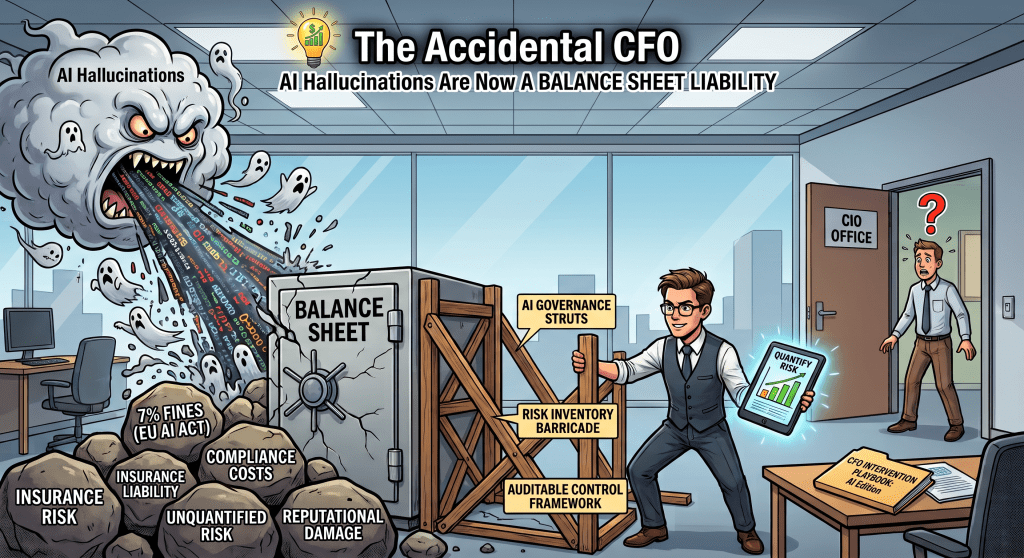
The era of viewing artificial intelligence purely as an abstract technology experiment is officially over. Today, AI risk is no longer just an IT problem—it has become a direct, quantifiable threat to your corporate balance sheet.
If your team is deploying AI models that hallucinate data or violate compliance standards, the financial consequences are now very real. This month, the regulatory landscape shifted dramatically. The EU AI Act became broadly applicable on August 2, 2026, bringing stronger regulatory enforcement into effect. Simultaneously, the U.S. is tightening its own frameworks, with NIST finalizing updates on June 30, 2026, to align security and privacy risk management plans.
As a finance leader, you can no longer afford to let the Chief Information Officer handle AI governance in a silo. Abstract technical risks have transformed into concrete financial liabilities that demand CFO oversight.
Here is why AI deployments must now be treated as material financial risks:
- Massive Regulatory Fines: Under the newly enforceable EU AI Act, maximum fines can reach 7% of global annual turnover. This significantly exceeds the GDPR’s 4% maximum. A penalty of that size is not just a compliance slap on the wrist; it is a devastating hit to your bottom line.
- Staggering Compliance Costs: Achieving regulatory alignment is not cheap. Compliance costs for large enterprises range from $8 million to $15 million, with third-party certification costing upwards of $50,000 per AI system in regulated industries.
- Insurance Liability: As organizations move from informal “AI ethics” discussions to robust governance structures, insurance underwriters are adjusting their premiums. If you cannot prove your AI models are continuously measured and managed, securing adequate cyber and liability coverage will become prohibitively expensive.
Despite these mounting financial stakes, corporate readiness remains alarmingly low. Recently, it was reported that over 50% of organizations still lacked a basic AI inventory.
To protect the balance sheet, finance leaders must urgently partner with Legal and IT to quantify these new exposures. Governance must now span the full AI lifecycle, from data acquisition and testing to deployment. Stop funding shadow IT projects, start demanding rigorous financial ROI for every pilot, and ensure your enterprise has a comprehensive inventory of all active models.
Has your executive team quantified the potential compliance costs and liabilities of your current AI tools, or are you still operating without a net?
#TheAccidentalCFO #FinanceLeadership #AIRisk #INERSEC #CFOPlaybook


Leave a Reply