
Stories and lessons from an unexpected journey in finance.
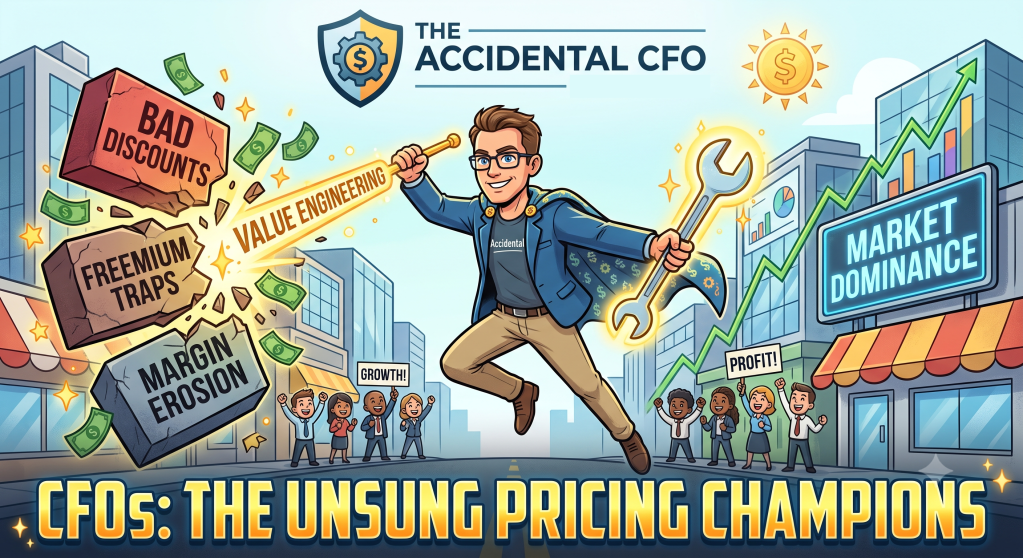
I was recently sitting in a go-to-market strategy session where the tension in the room was palpable. Sales wanted a massive discount to land a marquee logo. Marketing was pushing a new freemium tier to drive top-of-funnel volume. And everyone was staring at me, waiting for Finance to play its traditional role: the ultimate roadblock.
This is a classic trap. In most scaling organizations, pricing is treated almost entirely as a sales and marketing exercise. The finance team is usually only brought into the conversation at the eleventh hour to either rubber-stamp the margin or kill the deal entirely.
But here is the reality: Pricing is the single most powerful, yet underutilized, lever for value creation in any business. And the modern CFO is uniquely positioned to be its ultimate champion.
While Sales sees the top line and Marketing sees market share, the CFO is the only executive leader who sees the entire board. You sit at the exact strategic intersection of unit economics, customer acquisition costs, margin velocity, and operational capacity.
If you want to transition from a historical scorekeeper to a strategic business partner, you have to take an active seat at the pricing table. Here is exactly how you make that pivot:
- Shift from Gatekeeper to Deal Architect: Do not just veto bad discounts or block aggressive proposals. Build dynamic pricing guardrails and approval matrices that actually empower your sales team to negotiate profitably and quickly. Give them the actionable framework to win.
- Ditch the Cost-Plus Comfort Zone: It is incredibly easy for finance teams to default to cost-plus pricing because the underlying math feels safe. True pricing champions dig into the data alongside product teams to understand and capture the actual value delivered to the customer, rather than just covering internal expenses.
- Connect Pricing to Long-Term Retention: A closed deal is never a win if the pricing structure inherently incentivizes churn six months down the line. You must ensure your pricing tiers perfectly align with actual product usage, customer success, and scalable growth.
When a CFO stops just protecting the downside and starts actively engineering the upside, the entire growth trajectory of a company fundamentally changes for the better. You aren’t just managing the numbers on a static spreadsheet; you are designing the financial engine that drives sustainable scale.
Who actually owns the pricing strategy in your organization, and when does Finance get a seat at the table?
#CFO #PricingStrategy #StrategicFinance #TheAccidentalCFO


Leave a Reply