
Stories and lessons from an unexpected journey in finance.
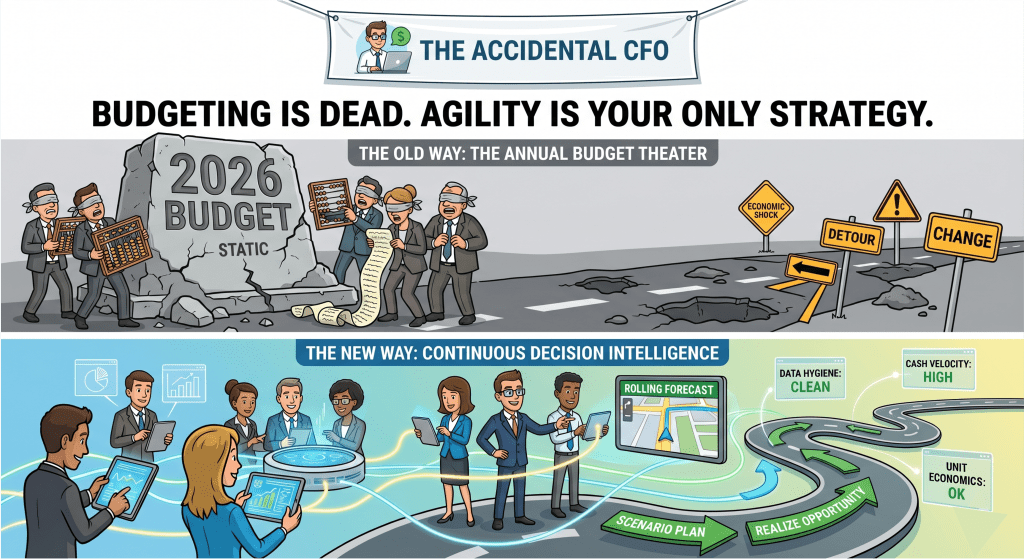
Running a business on a rigid annual budget in 2026 is like driving while looking in the rearview mirror.
Economic risks are shifting overnight. In March 2026, most economists anticipated the Federal Reserve would lower interest rates. Following a sudden oil price shock, inflation spiked to 3.8 percent. Now, the Fed’s June dot plot has shifted hawkishly, projecting potential rate hikes by year-end.
A macro environment that swings from expected rate cuts to rate hikes in three months invalidates any budget approved in December.
The Illusion of Control
The annual budgeting process is a corporate theater of false certainty. We spend months debating line items and sandbagging targets. Then we lock the spreadsheet and pretend the world will pause for twelve months so we can execute it.
When market volatility moves this quickly, periodic capital exercises are outmoded. If assumptions like debt-servicing rates or supply chains change dramatically in a single quarter, an inflexible budget becomes a dangerous liability.
The Shift to Rolling Agility
A strategic CFO must transition the company away from defensive budgeting and toward continuous decision-making as a real-time scenario engine.
Here is how modern finance teams are killing the annual budget:
- Rolling Forecasts: Move to a 12-to-18-month rolling forecast updated based on actuals. This forces the business to constantly look forward rather than managing to an arbitrary year-end.
- Driver-Based Planning: Stop budgeting fixed dollar amounts. Start budgeting based on operational drivers. If revenue drops 15%, variable expenses should recalculate instantly.
- Continuous Scenario Planning: Model “What If” scenarios before crises hit. What happens to your cash runway if interest rates rise or energy costs spike?
Agility is the ultimate competitive advantage. The companies that survive won’t be the ones that perfectly predicted the year—they will be the ones that adapted the fastest when the budget inevitably broke.
Be honest: How many weeks does your company waste on the annual budgeting process, only for the numbers to be completely wrong by February?
#INERSEC #FinancialPlanning #FPandA #RollingForecast #TheAccidentalCFO

 INERSEC
Leave a comment