
Stories and lessons from an unexpected journey in finance.
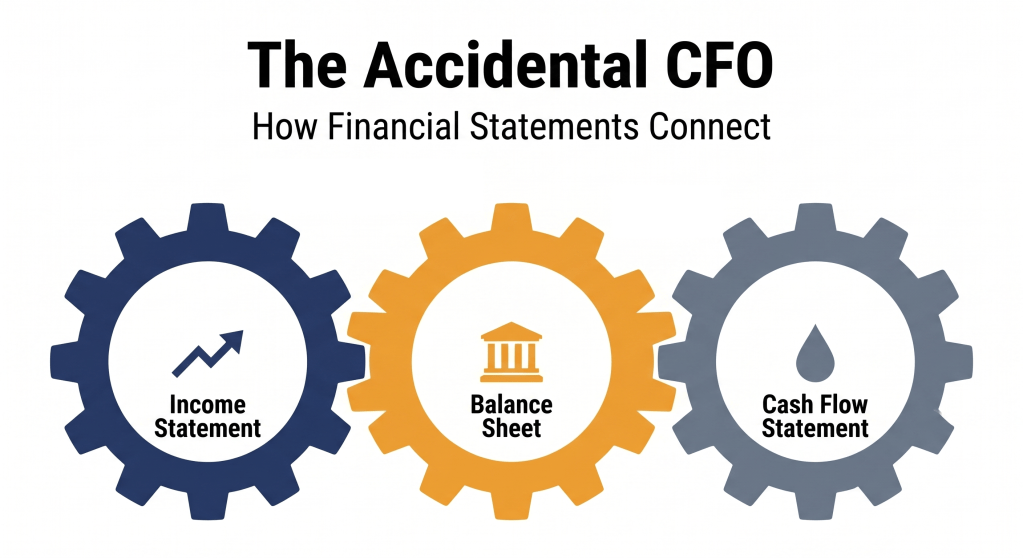
Most non-finance leaders make the same mistake: they treat the P&L like it is the entire story. They see a healthy net profit on the Income Statement and assume the business is thriving.
But the real truth of a business isn’t found in a single report. It is found in the plumbing that connects them. The Income Statement, Balance Sheet, and Cash Flow Statement are deeply interconnected. If you don’t understand how they talk to each other, you are flying blind. Here is how they link:
1. The Equity Engine (Income Statement → Balance Sheet)
Net profit does not just reset at month-end. It flows directly into Retained Earnings on the Balance Sheet. This is how profitability builds—or destroys—the fundamental equity of the enterprise.
2. The Paper Illusion (Depreciation)
Depreciation perfectly illustrates the three-statement dance. It hits your Income Statement as an expense and reduces the carrying value of equipment on the Balance Sheet. Because no cash left your bank, it gets added right back on the Cash Flow Statement.
3. The Working Capital Trap
This is where fast-growing companies run out of money. You recognize a massive surge in sales (Income Statement). But if the cash hasn’t arrived, your Receivables spike (Balance Sheet), and operating cash flow tanks. Profit is an accounting concept; cash is a physical reality.
4. The Ultimate Bridge (Cash Flow → Balance Sheet)
The Cash Flow Statement is the literal bridge connecting your past Balance Sheet to your current one. It categorizes why your cash balance changed across operating, investing, and financing activities. The ending number here must match the cash on your Balance Sheet.
5. The Echo of Capital Decisions
When you buy new equipment, the impact echoes everywhere. Your cash drops (Cash Flow), fixed assets rise (Balance Sheet), and future profits take a hit from upcoming depreciation (Income Statement). Major capital decisions ripple through time.
Ultimately, everything reconciles through the equation:
Assets = Liabilities + Equity
Because both profit and cash movements impact equity, the system is a perfect, closed loop.
Understanding this financial plumbing separates a good operational manager from a strategic leader. It allows you to spot risks early and see the true health of the business.
What is the most common misunderstanding you see non-finance leaders make when trying to read financial statements?
#TheAccidentalCFO #FinancialLiteracy #FPandA #StrategicFinance #inersec


Leave a Reply