
“Stories and lessons from an unexpected journey in finance.”
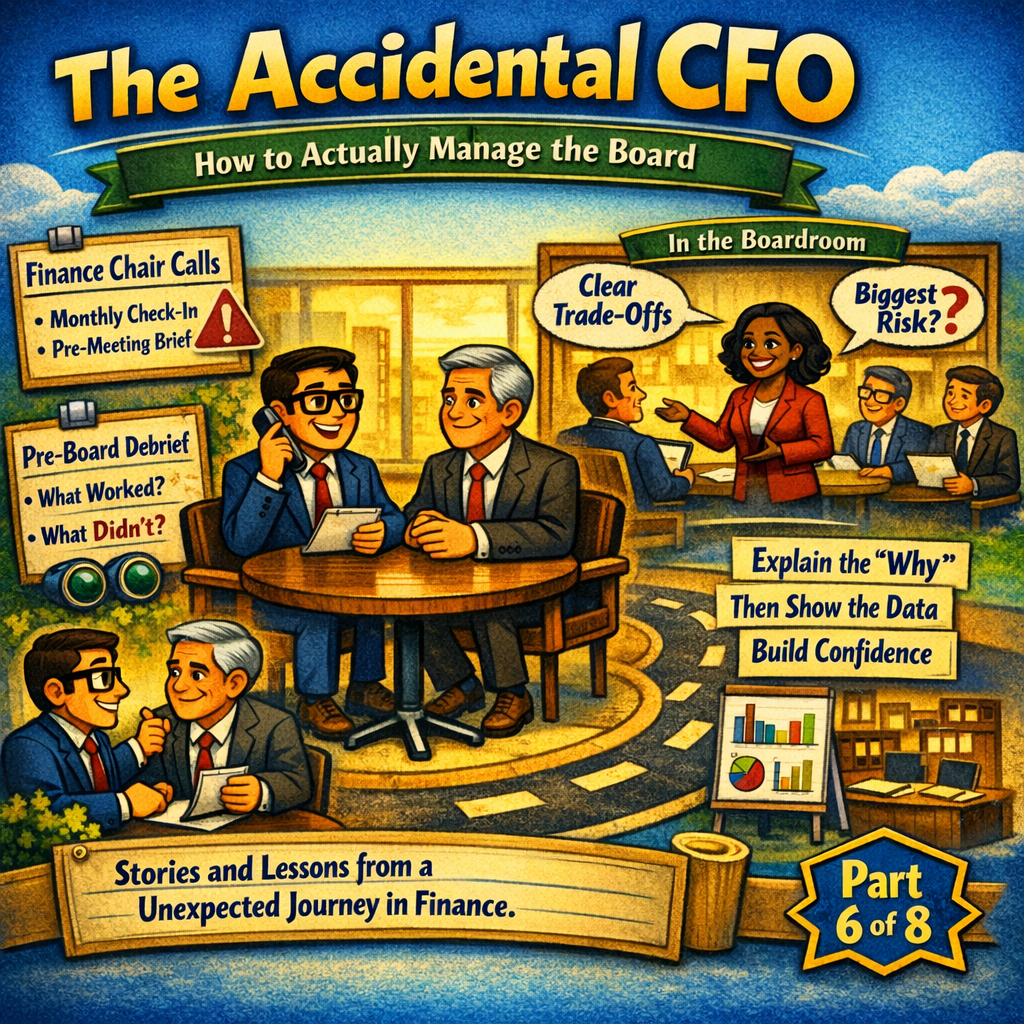
The Accidental CFO: Executive Relationships How-To Guide – Part Six
Boards do not primarily evaluate accuracy; they evaluate confidence. Specifically, they evaluate whether they believe management knows what it does not know, and whether risks are being proactively seen and managed rather than minimized and concealed.
A CFO who presents perfect numbers but cannot explain the logic behind a decision invites heavy scrutiny. A CFO who frames trade-offs clearly, names uncertainty explicitly, and explains how the organization is navigating it earns trust—even when the numbers are bad.
Your most important pre-work actually happens outside the boardroom with the Finance Chair. This relationship should receive the most intentional investment of any board connection:
- Monthly informal call: 20 minutes, forward-looking, no presentation deck.
- Pre-board-meeting brief: 48 hours before a session, walk them through the narrative, the numbers, and the expected questions.
- Post-board debrief: Within 24 hours, close the loop on what landed and what didn’t.
When you are actually presenting, the structure of your narrative matters as much as the data. Leading with data and then explaining it gives the board a puzzle to solve. Leading with the question and then providing the data that answers it guides the board to a conclusion. Name the biggest risk explicitly in the body of the presentation—never bury it defensively in the footnotes.
What is the most effective way you’ve found to “pre-wire” a difficult conversation before a major board meeting?
Next up: The quiet career killer most CFOs don’t see coming — and the two-question filter that fixes it.
#TheAccidentalCFO #inersec #BoardOfDirectors #CorporateGovernance #StrategicCommunication


Leave a Reply