
“Stories and lessons from an unexpected journey in finance.”
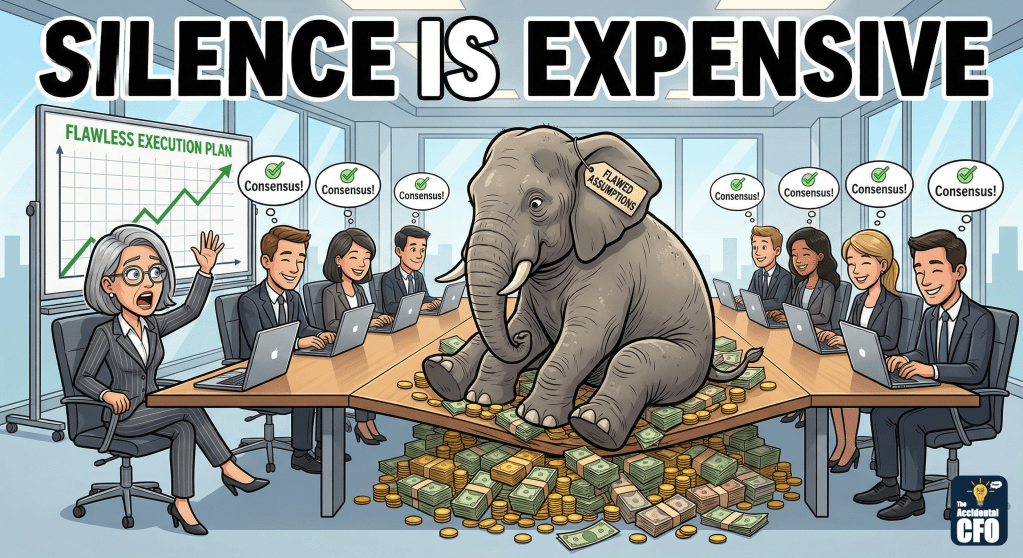
I once sat in a steering committee where we approved a massive, seven-figure software migration. The slide deck was flawless. The ROI projections were green. Everyone around the table nodded in agreement.
But the lead implementation engineer at the end of the table was staring at his shoes.
I saw it, but I didn’t say anything. I thought my only job was to verify the budget, not question the execution. That polite silence ended up costing us six months of delayed rollout and hundreds of thousands of dollars in overrun fees.
Early in my career, I thought keeping my head down and just running the numbers was the safe play. But I learned the hard way: In business, silence isn’t golden. It is wildly expensive.
When you finally get a seat at the table, your job isn’t just to nod at the P&L and keep the meeting moving. It’s to look for the friction no one else wants to talk about. If you are harboring a doubt, spotting a misaligned incentive, or seeing a gap in the baseline assumptions, keeping it to yourself isn’t polite—it’s professional negligence.
Here is how you stop paying the “silence tax” and step fully into your role as a Strategic Navigator:
1. Interrogate the Nodding Heads
When a risky proposal gets zero pushback, that isn’t true consensus. It is usually exhaustion, apathy, or fear. Learn to read the room. If the operations lead is agreeing but looking at the floor, pause the meeting. Ask, “If this fails in month three, what will be the reason?” Give them the runway to voice the hidden friction.
2. Be the Dissenter
Most teams get stuck in asking: How do we do this faster? A true leader stops the room and asks: Why are we assuming this is the right thing to do at all? It is deeply uncomfortable to be the one slowing down a moving train, but a five-minute uncomfortable pause is infinitely cheaper than a nine-month post-mortem.
3. Trade Silent Judgment for “Yes, If…”
You don’t have to play the corporate bouncer to speak up. Instead of sitting in silent judgment of a flawed plan, vocalize the risk constructively. Change the dynamic from adversary to architect by saying, “Yes, we can fund this, if we test it on a smaller cohort first to validate these conversion assumptions.”
The Bottom Line:
The next time you are in a meeting and feel that knot in your stomach telling you the plan is flawed, clear your throat. The only thing more uncomfortable than interrupting a confident room is explaining to the board next quarter why you let a bad plan happen.
What is the most expensive lesson your team ever learned because someone in the room was afraid to speak up?
#TheAccidentalCFO #inersec #FinanceLeadership #Leadership #StrategicFinance


Leave a Reply