
“Stories and lessons from an unexpected journey in finance.”
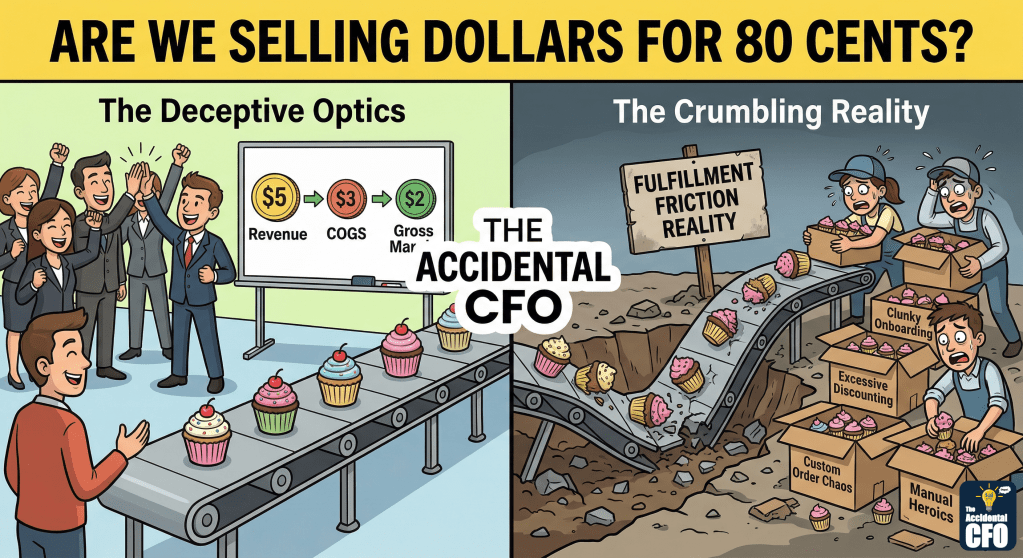
In my “Cupcake Shop” post last year, we established a weak gross margin is like frosting air. If every sale makes you hungrier instead of richer, it’s not growth—it’s a sugar high.
Let’s go a layer deeper. If your unit economics are secretly upside down, hitting the gas won’t build a scalable company. You are just scaling a disaster.
Take our $5 cupcake. On a perfect spreadsheet, ingredients cost $3, leaving a $2 gross margin. But in the real world, when you dig into actual operations, you realize that $3 cost is a lie.
How does a smart company fall into this trap and end up effectively selling dollars for 80 cents? It happens through a thousand tiny, well-intentioned cuts:
- Sales aggressively discounts to hit quota.
- Operations adds manual labor to fulfill custom orders.
- Customer Success throws bodies to fix a clunky user experience.
Everyone is just trying to survive the quarter. But collectively? The true cost to deliver one single unit of value just skyrocketed. If you bury those manual heroics “below the line”, your gross margin looks perfectly healthy on paper—while your cash silently bleeds out. Remember, confusing revenue growth with financial health is a very common trap for founders and seasoned operators alike.
To step up as a Strategic Navigator, you have to fix the engine before you add more fuel. Here is how you redraw the map:
1. Expose the True COGS Stop hiding delivery costs. If a human must touch the product, wrangle data, or hold a customer’s hand to make baseline value work, that is a Cost of Goods Sold. Don’t lie to make the board deck look pretty.
2. Apply “Enterprise Empathy” to Pricing Don’t just play the corporate bouncer and blindly ban all discounts. Sit down with Sales. Why are they discounting? Is the market shifting? Use Enterprise Empathy to understand their friction and help them build a pricing strategy that reflects actual pricing power.
3. Kill the Fulfillment Friction If your delivery mechanism relies on manual spreadsheets and heroics, you can’t scale. Look at where you can deploy workflow automation and Agentic AI—not just to close the accounting books faster, but to streamline the actual operational delivery of your product.
The Bottom Line: Gross margin is your first line of defense. If your unit economics are positive, growth adds fuel to the mission. If your unit economics are negative, every new sale just digs the hole deeper. Before you press the gas pedal on scaling, make sure you aren’t just selling dollars for 80 cents.
What is the most common hidden cost you see quietly destroying a company’s unit economics?
#TheAccidentalCFO #inersec #UnitEconomics #COGS #StrategicFinance


Leave a Reply