
“𝘚𝘵𝘰𝘳𝘪𝘦𝘴 𝘢𝘯𝘥 𝘭𝘦𝘴𝘴𝘰𝘯𝘴 𝘧𝘳𝘰𝘮 𝘢𝘯 𝘶𝘯𝘦𝘹𝘱𝘦𝘤𝘵𝘦𝘥 𝘫𝘰𝘶𝘳𝘯𝘦𝘺 𝘪𝘯 𝘧𝘪𝘯𝘢𝘯𝘤𝘦.”
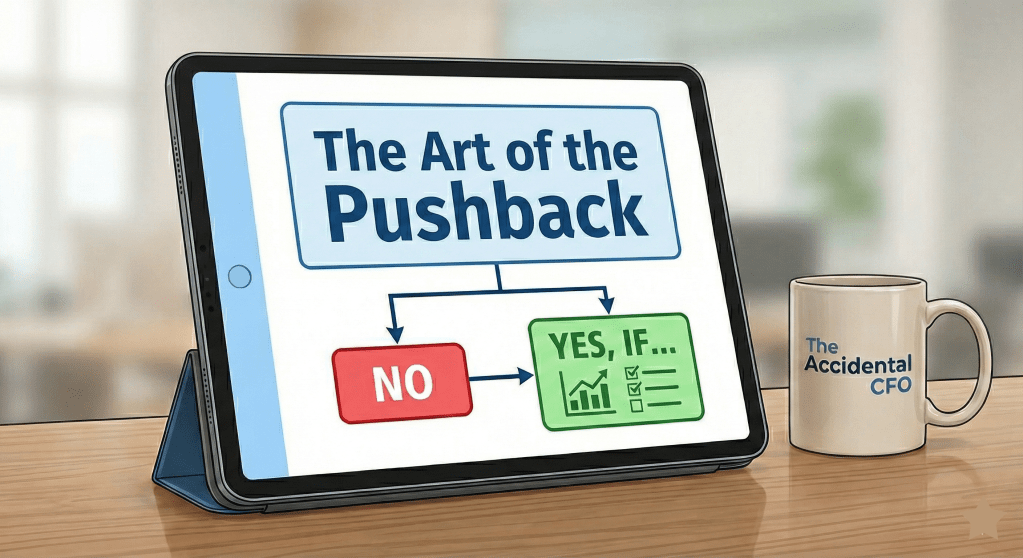
Last year, I wrote a post about why the best CFOs sometimes make people uncomfortable. It resonated because, deep down, we all know that growth doesn’t happen in the comfort zone. Our job is to hold up a mirror to the business reality, and sometimes that reflection isn’t pretty.
But there is a massive difference between being a necessary point of friction and just being a jerk.
Early in my journey into finance leadership, I made the mistake of thinking my primary job was protecting the bank account. When a department head came to me with an unbudgeted idea, my default setting was “No.” I thought I was being a responsible steward of capital. In reality, I was just becoming the dreaded “𝗖𝗙-𝗡𝗼”—a corporate roadblock where enthusiasm went to die.
I realized that if I wanted a seat at the strategy table, I had to stop acting like a bouncer and start acting like a navigator. I had to learn “The Art of the Pushback.”
A successful pushback isn’t about denial; it’s about prioritization. It’s not personal; it’s mathematical. Here is how I try to approach saying “no” without burning bridges:
𝟭. 𝗩𝗮𝗹𝗶𝗱𝗮𝘁𝗲 𝘁𝗵𝗲 𝗚𝗼𝗮𝗹, 𝗖𝗵𝗮𝗹𝗹𝗲𝗻𝗴𝗲 𝘁𝗵𝗲 𝗧𝗮𝗰𝘁𝗶𝗰
Never dismiss the intent behind the request. If Marketing wants $100k for a splashy new campaign, their goal is growth. That’s a good goal. Acknowledge it. “I love the ambition here, and I agree we need to boost lead gen.”
𝟮. 𝗨𝘀𝗲 𝗗𝗮𝘁𝗮, 𝗡𝗼𝘁 𝗢𝗽𝗶𝗻𝗶𝗼𝗻
“I don’t think this is a good idea” sounds arbitrary and condescending. Instead, show them the scoreboard. “Based on our current customer acquisition costs, spending $100k right now would require us to close 50 new enterprise deals just to break even on the spend. Do we have that in the pipeline?”
𝟯. 𝗧𝗵𝗲 “𝗬𝗲𝘀, 𝗜𝗳…” 𝗔𝗹𝘁𝗲𝗿𝗻𝗮𝘁𝗶𝘃𝗲
The best pushbacks offer a different path to the same destination. Instead of a hard “no,” try a conditional “yes.” “We can’t release $100k today. But, if you can run a $10k test this month and prove out the ROI models you just presented, I will happily unlock the other $90k next quarter.”
When done correctly, a pushback doesn’t damage the relationship. It actually strengthens it. It shows your peers that you aren’t just minding the store; you are invested in helping them win—safely.
𝗤𝘂𝗲𝘀𝘁𝗶𝗼𝗻: What’s the best “no” you’ve ever received in your career—the one that actually helped you in the long run?
#Leadership #CFOInsights #inersec #Negotiation #TheAccidentalCFO

 inersec
Leave a comment