
“Stories and lessons from an unexpected journey in finance.”
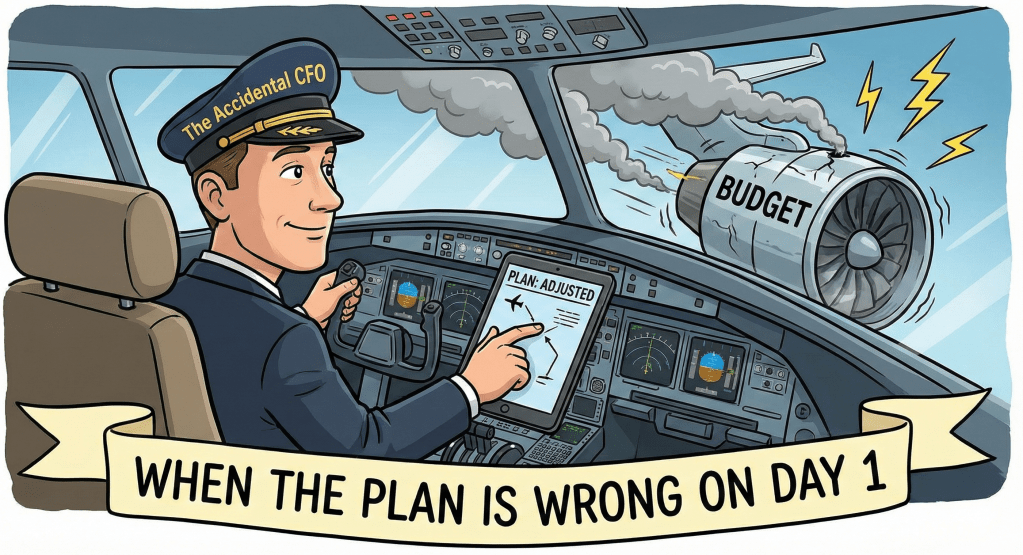
It’s a scenario every finance leader knows too well. You spend October and November locked in conference rooms, arguing over basis points and headcount. You refine the model until it’s a work of art. By January 1st, you have a “perfect” budget—a pristine map for the year ahead.
Then, February 1st arrives. You run the January actuals, and the map doesn’t match the terrain.
Maybe a key customer delayed a contract. Maybe an expense line exploded due to a vendor price hike. Whatever the reason, your “Day One” plan is already wrong. For the CFO, this is the moment where the job shifts from accounting to true leadership.
Building the Plane—Again
Last year, I wrote about “Building the Plane While It’s Flying.” This is the reality of the role. A budget isn’t a stone tablet; it’s a flight plan. And any pilot will tell you that as soon as you hit unexpected turbulence, you don’t keep flying into the storm just because the original plan said it would be sunny. You adjust.
When January misses the mark, your first instinct might be to panic or, worse, to hide the gap and hope February makes up for it. Don’t. Integrity isn’t optional in this seat. The best thing you can do is acknowledge the “wrongness” of the plan immediately.
Three Steps for the January Pivot
- Diagnose the “Why” (The Storyteller Role): Was the miss a timing issue or a structural issue? If a sale just moved to February, that’s a ripple. If your customer acquisition cost is 20% higher than modeled, that’s a leak in the tank. You need to tell the story behind the numbers to your CEO before they see the spreadsheet.
- The 80/20 of Course Correction: Don’t try to fix every line item. Focus on the 20% of drivers that will impact the next 90 days. As the CFO, your job is to be the “Translator”—take the complex mess of a budget miss and turn it into three clear actions for the executive team.
- Shorten the Feedback Loop: If the plan is wrong on Day One, you can’t wait until the end of Q1 to check in again. Move to a rolling forecast. If the plane is shaking, you check the instruments more often, not less.
The Goal Isn’t Accuracy; It’s Agility
Your value as a CFO isn’t in your ability to predict the future with 100% accuracy. Nobody can do that. Your value is in your ability to navigate the reality of the present.
If your January looks different than you hoped, congratulations—you just got your first real data set of the year. Use it to build a better plane for February.
Question: How did your January “Actuals” stack up against your “Budget”? Did you find a ripple or a leak, and how are you pivoting for the rest of Q1?
#TheAccidentalCFO #FinancialPlanning #Leadership #inersec #CFOInsights

 inersec
Leave a comment