
“Stories and lessons from an unexpected journey in finance.”
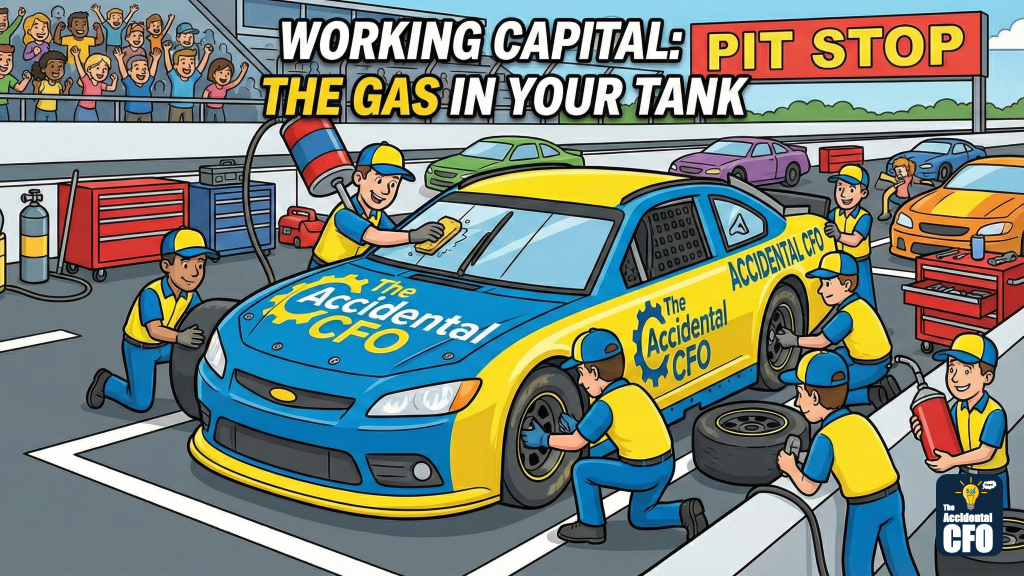
If you’ve been following along, you know I like to strip away the corporate jargon and look at the “bones” of a business. We’ve talked about Gross Margin through the lens of a cupcake shop and Free Cash Flow as your “Netflix money.” Today, we’re tackling a term that makes many non-finance leaders’ eyes glaze over: Working Capital.
In the world of “The Accidental CFO,” I don’t think of Working Capital as a complex formula hidden on a balance sheet. I think of it as the gas in your tank.
The Road Trip Reality
Imagine you’re driving from New York to LA. Your “Profit” is the destination—it’s where you want to end up. But your “Working Capital” is the fuel currently in the gas tank. You can have a perfect map, a fast car, and a great destination, but if you run out of gas in the middle of Nebraska, the trip is over.
In business, you “run out of gas” when your Working Capital hits zero, even if your business is technically profitable on paper.
The Three Ingredients of the Fuel
To understand how much gas you have, you only need to look at three things:
- Accounts Receivable (AR): The “I.O.U.” Think of this as fuel you’ve already paid for, but the pump is locked. You’ve done the work and delivered the product, but the customer hasn’t handed over the cash yet. The longer it stays in AR, the longer you’re driving on fumes.
- Inventory: The Spare Tires This is cash sitting in your warehouse (or your kitchen) in the form of raw materials or finished goods. It’s necessary, but you can’t buy lunch with a spare tire. If you have too much inventory, you have too much cash tied up in the trunk instead of in the engine.
- Accounts Payable (AP): The Credit Card This is the fuel you’ve put in the tank but haven’t paid for yet. It’s a delicate balance; paying too fast drains your tank, but waiting too long means the gas station (your vendors) won’t let you fill up next time.
Why You Should Care
Early in my journey, I learned the hard way that finance isn’t just numbers—it’s about timing. Working Capital is the art of managing that timing.
If your customers take 60 days to pay you (AR), but you have to pay your suppliers in 30 days (AP), you have a “fuel leak.” You need enough cash—Working Capital—to bridge that 30-day gap.
As a leader, your job isn’t just to make the car go fast (growth); it’s to make sure you have enough gas to get to the next station. Because while profit is the goal, cash is the oxygen—and working capital is the tank that holds it.
Question: What’s one area of your business where you feel like “cash is getting stuck”? Is it slow-paying customers (AR) or too much “spare tire” (Inventory)?
#WorkingCapital #CashFlow #TheAccidentalCFO #Finance #inersec

 inersec
Leave a comment