
“Stories and lessons from an unexpected journey in finance.”
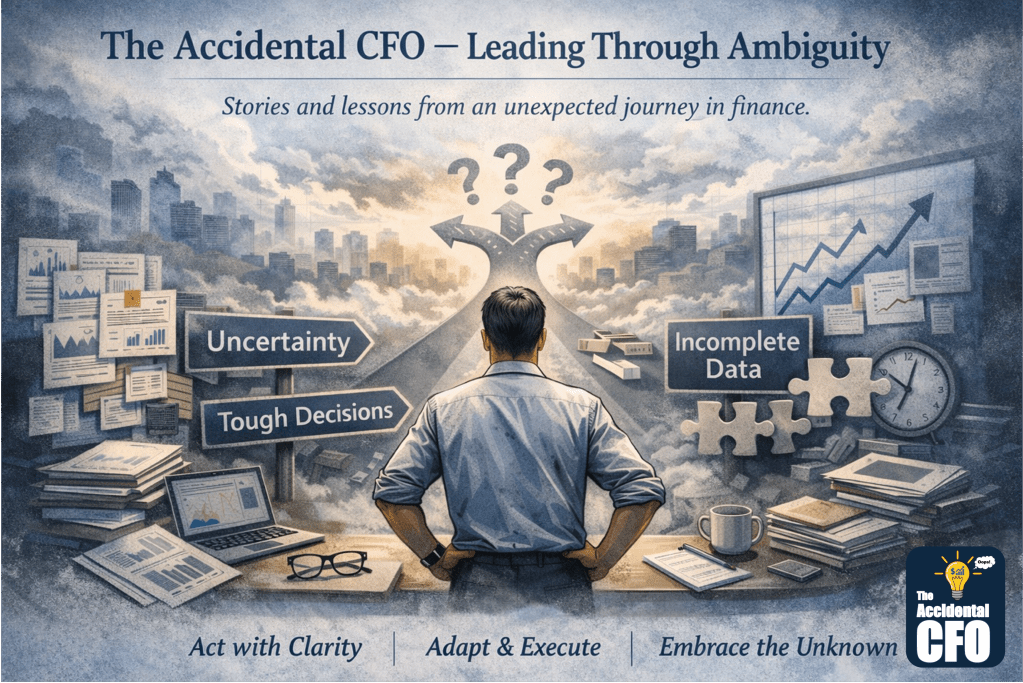
One of the toughest challenges for any CFO isn’t closing the books or hitting targets. It’s leading when you don’t have all the answers. Whether you’re in a high-growth SaaS company, a PE-backed business, or a unit emerging from operational strain, ambiguity is constant. Every quarter, there are revenue targets to meet, operational gaps to address, and strategic initiatives to advance, often with incomplete data and competing priorities.
In those moments, the temptation is to wait until everything is “perfect” before making a decision. The reality? Perfect doesn’t exist. The most effective finance leaders I’ve seen embrace uncertainty and act decisively with the information available. They focus on directionally correct moves rather than paralysis by analysis, knowing that speed and clarity often outweigh absolute precision in rapidly evolving environments.
For example, when I recently stepped into a new role as CFO, the company was in the middle of an aggressive growth phase while simultaneously integrating two acquisitions. The reporting was fragmented, customer revenue data was inconsistent, and many strategic initiatives were competing for the same resources. Waiting for a “perfect” dataset would have meant stalling critical decisions on pricing, resource allocation, and acquisition integration. Instead, I focused on identifying the decisions with the highest impact, setting interim checkpoints, and clearly communicating assumptions to the team.
This approach allowed us to act decisively. We adjusted pricing strategies based on partial but reliable data, prioritized integrations that delivered immediate efficiencies, and kept the board informed with transparent projections that acknowledged uncertainty. By acting with clarity rather than waiting for certainty, we were able to accelerate growth, improve profitability, and gain the confidence of investors, all while maintaining the trust of the team and organization.
Ambiguity also presents opportunities. It forces you to think creatively, leverage insights from cross-functional partners, and challenge assumptions. Acting decisively while acknowledging risk is what separates reactive finance teams from proactive, strategic leaders.
I’ve learned that finance isn’t just about numbers. It’s about judgment under uncertainty, balancing risk with opportunity, and ensuring that every move — even amid incomplete information — moves the business forward. It’s a skill that can’t be taught in a textbook; it’s earned in the cockpit of real-world transformation.
💡 Question for finance leaders: How do you approach decision-making when the data is incomplete but the pressure to act is high? What frameworks or habits have helped you navigate ambiguity successfully?
#CFO #Ambiguity #inersec #TheAccidentalCFO

 inersec
Leave a comment