Stories and lessons from an unexpected journey in finance.
When you step into a large public company or global enterprise, the CFO role transforms again—this time into one defined by scale, governance, and orchestration.
During the years I led multi-billion-dollar business units, the complexity was unlike anything earlier in my career. You’re no longer building systems or driving turnarounds—you’re navigating a massive, integrated machine that has global implications with every decision.
Risk management becomes central.
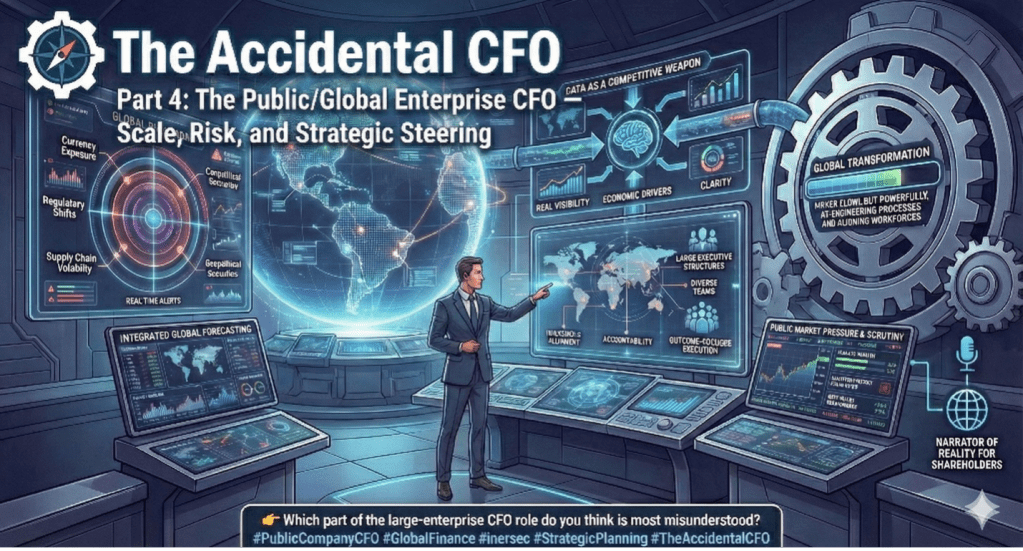
From global restructuring programs to multimarket scenarios, the CFO becomes the guardian of enterprise risk. You manage currency exposure, regulatory environments, supply chain volatility, and investor expectations—all at once.
Planning becomes geopolitical, not just operational.
Forecasting involves dozens of markets, thousands of people, and billions in revenue. One shift in the economy, one competitor move, one regulatory change can alter the entire plan. The CFO is the strategist connecting the dots.
Influence replaces direct control.
You lead through complex matrices, diverse cultures, and large executive teams. I learned quickly that success required influence more than authority—aligning regional leaders, driving accountability, and keeping the organization focused on outcomes rather than activity.
Data becomes a competitive weapon.
In one enterprise role, I championed new planning tools and redesigned global dashboards, giving leadership real visibility into the economic drivers across the business. When decisions move millions of dollars at a time, clarity is everything.
Transformation at scale becomes slow but powerful.
You’re not changing a budget spreadsheet—you’re realigning global workforces, re-engineering processes, or deploying enterprise systems. The cycles are long, the stakes high, and the required precision immense.
Public markets add their own pressure.
Analyst expectations, quarterly scrutiny, and reputation management create another layer of discipline—and sometimes friction. The CFO becomes the narrator of reality for shareholders.
This version of the role requires diplomacy, deep operational insight, and the ability to think globally while executing locally. It’s the highest altitude you can operate at in finance—and the most complex.
👉 Which part of the large-enterprise CFO role do you think is most misunderstood?
#PublicCompanyCFO #GlobalFinance #inersec #StrategicPlanning #TheAccidentalCFO

 inersec
Leave a comment